TL;DR
Dialectical behavior therapy (DBT) is a skills-based talk therapy built to help people manage intense emotions without turning to harmful behavior, including drinking or drug use.
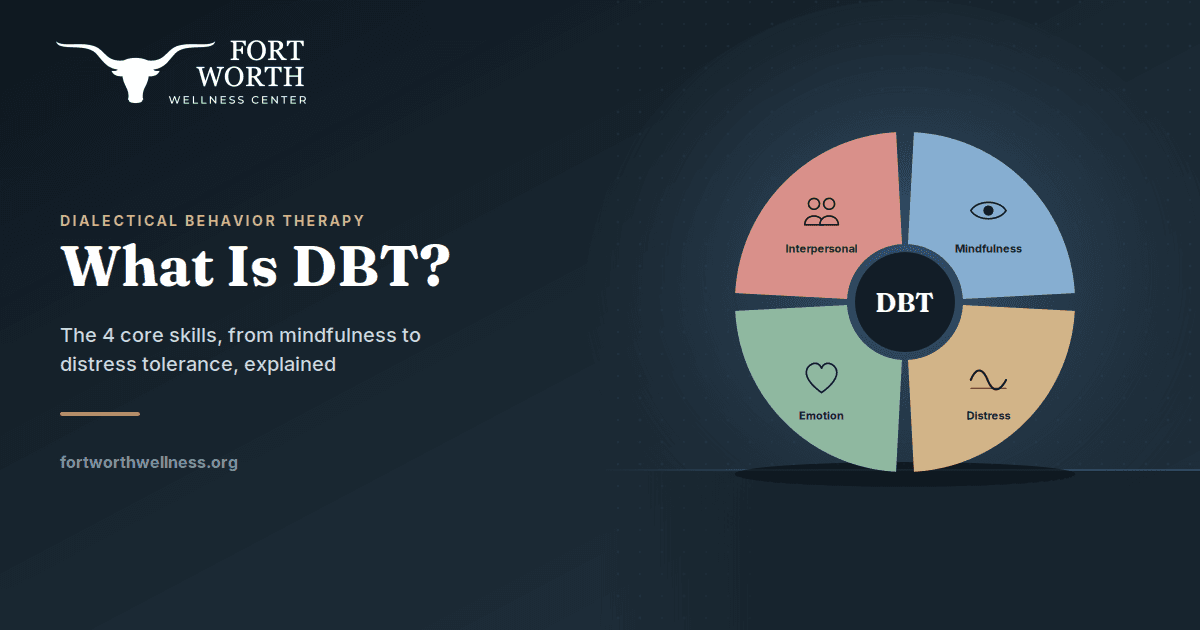
It teaches four skill sets: mindfulness, distress tolerance, emotion regulation, and interpersonal effectiveness.
DBT is delivered through individual therapy, a weekly skills group, and between-session coaching.
It fits people whose substance use is tied to emotional overwhelm, impulsive behavior, or painful relationships.
Fort Worth Wellness can tell you whether DBT belongs in your treatment plan after an assessment.
Table of Contents
What is dialectical behavior therapy (DBT)? A plain-language overview
How DBT supports addiction recovery and co-occurring mental health conditions
What to expect from DBT: individual therapy, skills groups, and coaching
Introduction
Some people drink or use because they enjoy it. Many others do it because a feeling got too big to sit with: anger, shame, panic, emptiness. The substance works fast, and that is the trap.
If that sounds like you or someone you love, you may have come across DBT and wondered what it actually is. This article answers the question "what is Dialectical Behavior Therapy" in plain terms, walks through its four core skills with real examples, and explains how it is used in addiction treatment. If you need help finding treatment right now, SAMHSA's helpline is 1-800-662-HELP (4357), and the treatment locator at FindTreatment.gov is free.[1]
What is dialectical behavior therapy (DBT)? A plain-language overview
Dialectical behavior therapy is a structured form of talk therapy that teaches specific, practical skills for handling painful emotions and difficult situations. Psychologist Marsha Linehan developed it in the late 1980s, first for people with chronic suicidal thoughts and borderline personality disorder. Clinicians have since adapted it for many other problems, including substance use.
"Dialectical" means holding two things that seem to conflict and finding room for both. In DBT, the two things are accepting yourself as you are and working to change. So when people ask what Dialectical Behavior Therapy is at its simplest, the answer is this: a therapy that says "you are doing the best you can" and "you need to do better" in the same breath, and means both.
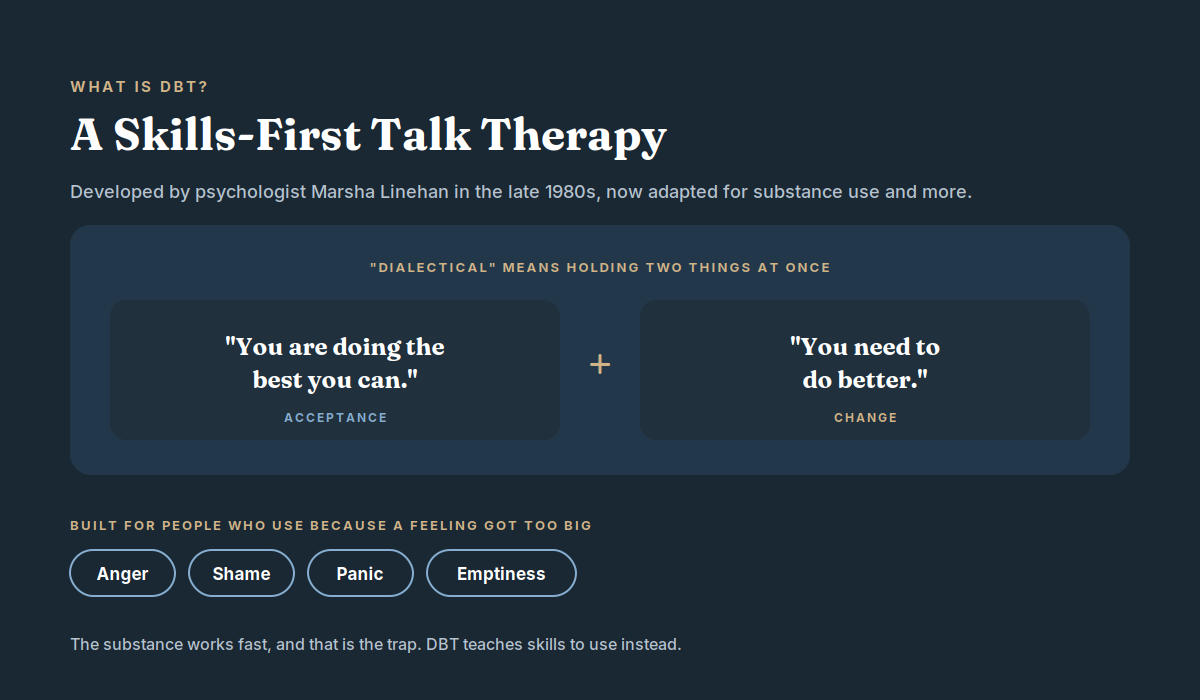
How DBT works: the balance between acceptance and change
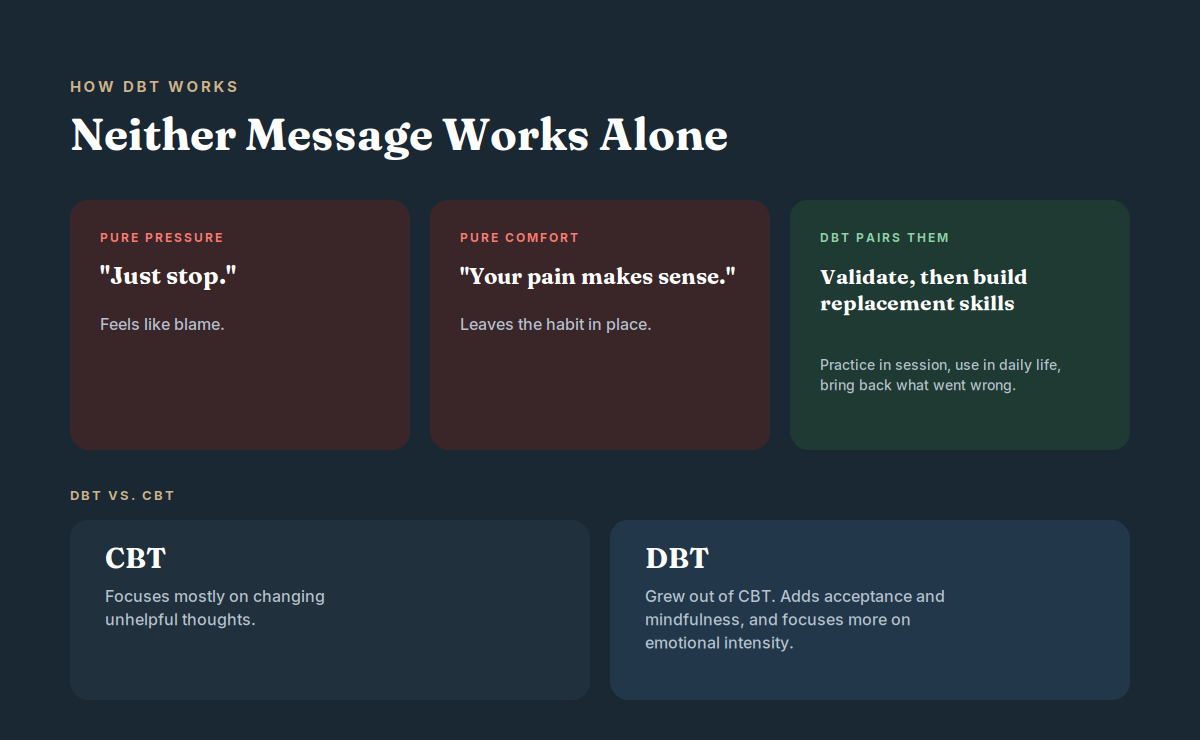
Many people in recovery have been told to just stop. Others have been told their pain is understandable and nothing more. Neither message works alone. Pure pressure feels like blame. Pure comfort leaves the habit in place.
DBT pairs the two. Your therapist validates that your emotions make sense given your history. Then you both get to work on building replacement skills. You practice them in session, use them in daily life, and bring back what went wrong so the plan can be adjusted.
DBT also differs from standard cognitive behavioral therapy (CBT). CBT focuses mostly on changing unhelpful thoughts. DBT adds acceptance and mindfulness, and it spends more time on emotional intensity. If you want a closer look at CBT and related approaches, see our guide to anxiety therapy: what works and how to start.
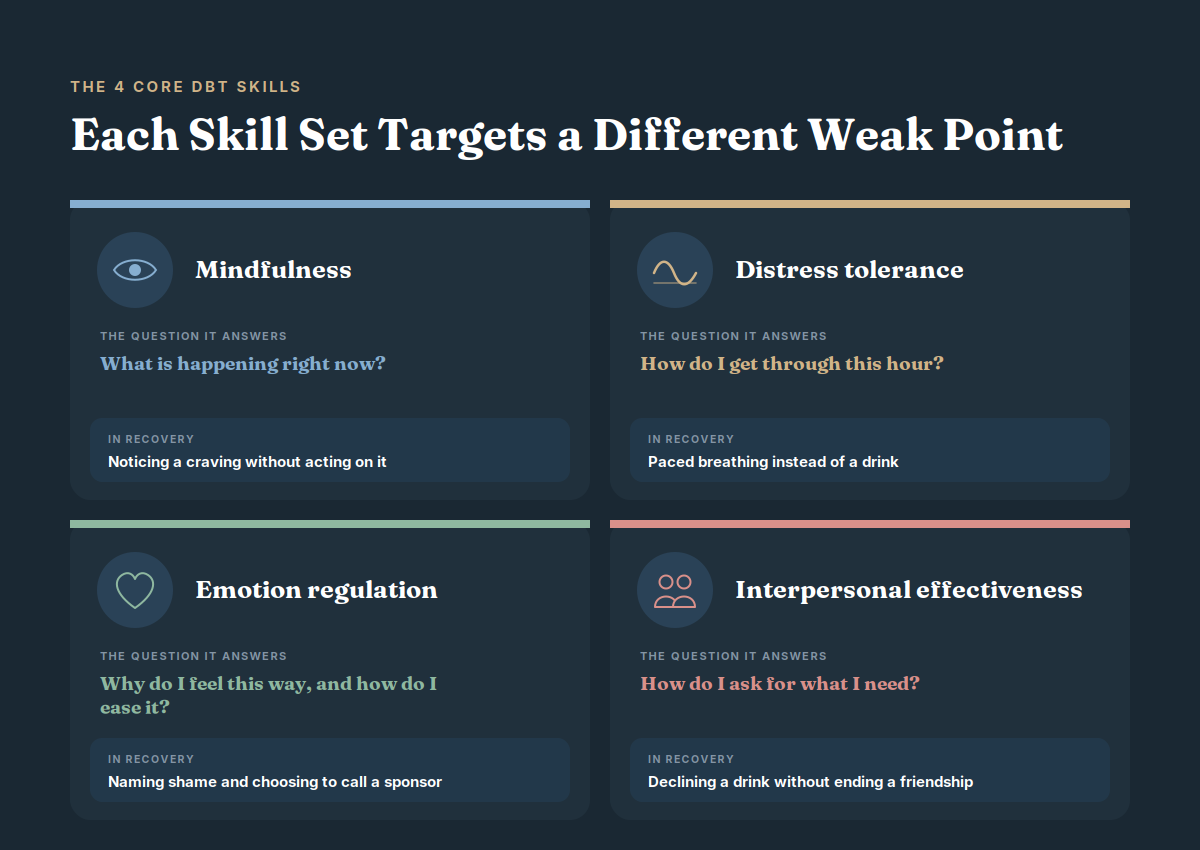
The 4 core DBT skills: mindfulness, distress tolerance, emotion regulation, and interpersonal effectiveness
Each skill set targets a different weak point. Here is how they look in real life.
Mindfulness
Mindfulness is noticing what is happening in your body, thoughts, and surroundings without judging it or reacting right away. A craving is a good example. Instead of fighting it or obeying it, you notice it rise, name it, and watch it change. Most cravings peak and fade if you do not feed them.
Distress tolerance
Distress tolerance is getting through a crisis without making it worse. Skills include splashing cold water on your face to slow your heart rate, intense exercise, paced breathing, and distracting yourself on purpose until the wave passes. These are not cures. They buy you the twenty minutes in which you do not drink.
Emotion regulation
Emotion regulation is learning to understand what you feel and reduce how vulnerable you are to it. You learn to name emotions accurately, notice what sets them off, and protect the basics: sleep, food, movement, and treatment of physical illness. You also practice doing the opposite of what an emotion urges, such as reaching out when shame says to hide.
Interpersonal effectiveness
Interpersonal effectiveness is asking for what you need, saying no, and keeping relationships intact while you do it. For many people in recovery, this means refusing a drink from a friend or repairing trust with family after years of conflict.
Skill set | Main question it answers | Example in recovery |
|---|---|---|
Mindfulness | What is happening right now? | Noticing a craving without acting on it |
Distress tolerance | How do I get through this hour? | Cold water and paced breathing instead of a drink |
Emotion regulation | Why do I feel this way, and how do I ease it? | Naming shame and choosing to call a sponsor |
Interpersonal effectiveness | How do I ask for what I need? | Declining a drink without ending a friendship |
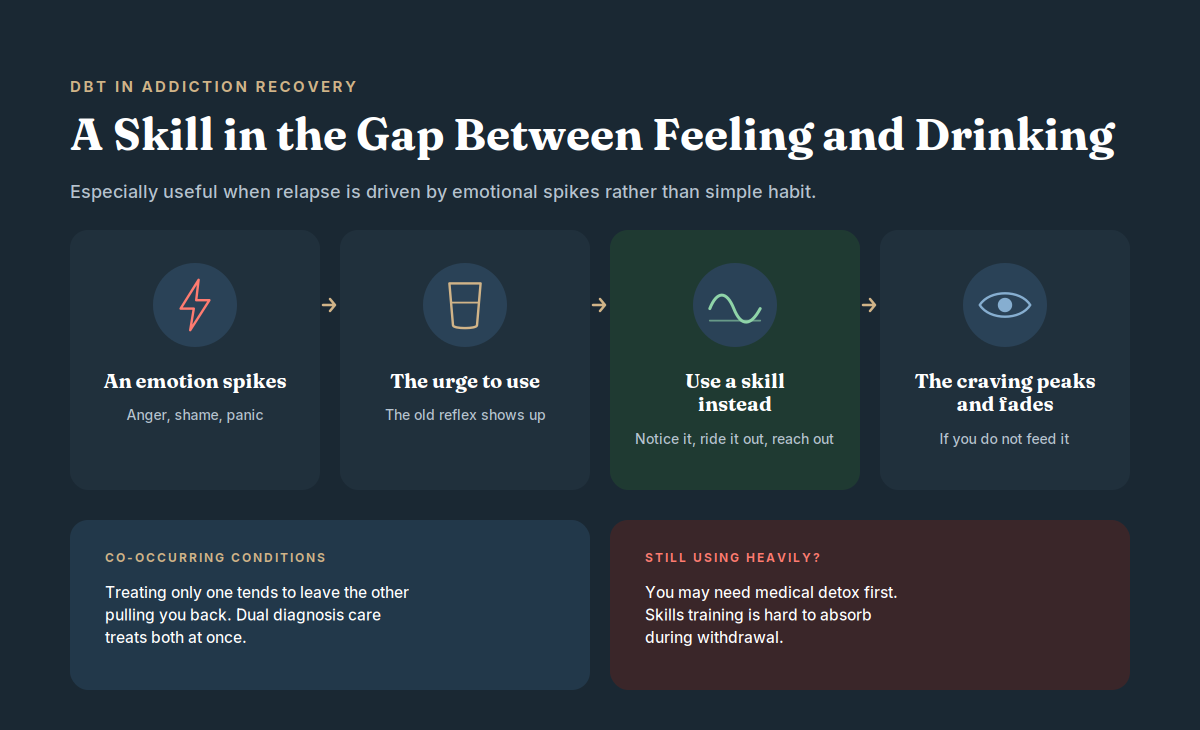
How DBT supports addiction recovery and co-occurring mental health conditions
Substance use and emotional pain often travel together. The National Institute on Drug Abuse describes treatment as something that should be matched to the person, and behavioral therapies are a core part of that care.[2] DBT is one behavioral option, and it is especially useful when relapse is driven by emotional spikes rather than simple habit.
Alcohol use follows the same pattern for many people. The National Institute on Alcohol Abuse and Alcoholism lists treatment options for alcohol problems that include behavioral approaches alongside medication.[3] Skills like distress tolerance give you something to do in the moment that is not a drink.
When a mental health condition and a substance use disorder exist together, treating only one tends to leave the other pulling you back. The ASAM Criteria, a set of guidelines for building treatment plans, takes a person-centered approach to patients with addiction and co-occurring conditions.[4] Our dual diagnosis program treats both at once. Clinicians define and classify these conditions using the DSM-5-TR, the standard reference for mental disorders.[5]
One caution: if you are still using heavily, you may need medical detox first. Skills training is hard to absorb during withdrawal.
What to expect from DBT: individual therapy, skills groups, and coaching
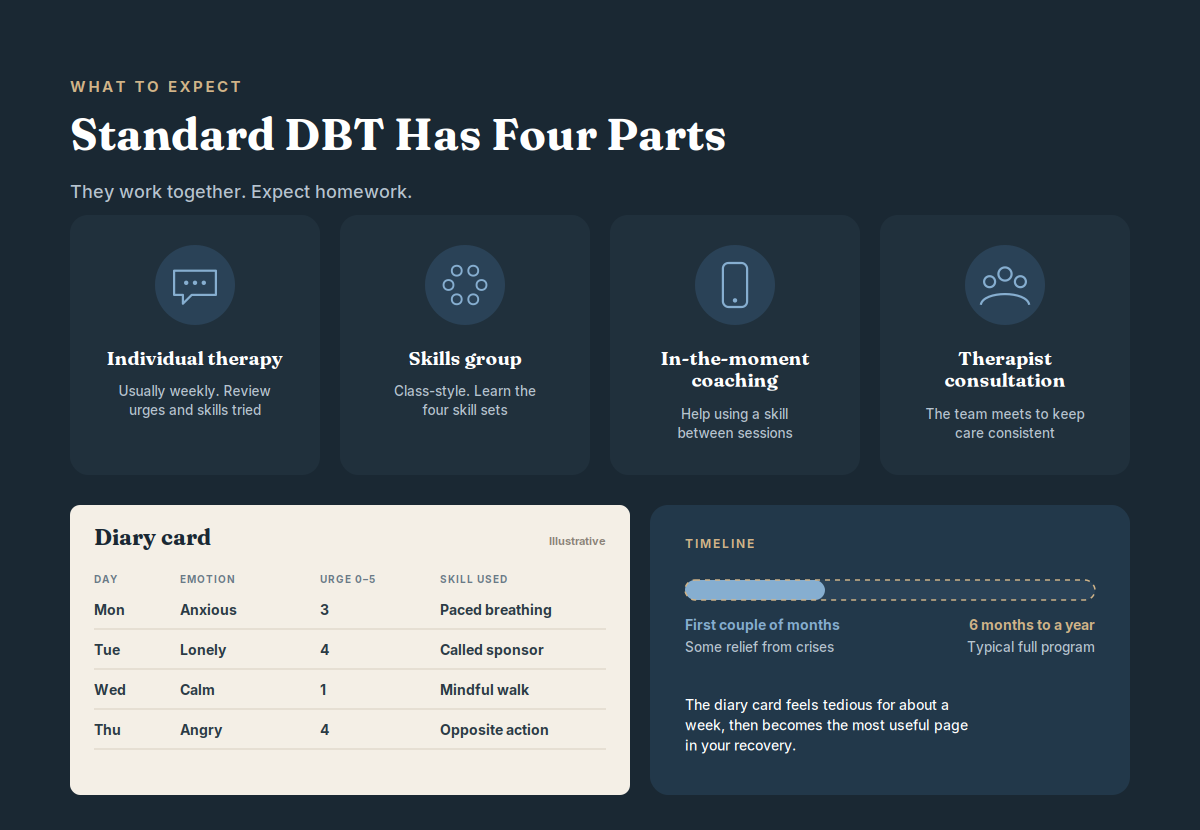
Standard DBT has several parts that work together.
Individual therapy: usually weekly. You and your therapist look at what happened that week, which urges came up, and which skills you tried.
Skills group: a class-style group where you learn the four skill sets and do homework. It is not group confession. You are there to learn and practice.
Phone or in-the-moment coaching: in the original model, you can reach your therapist between sessions for help using a skill during a crisis.
Therapist consultation: the treatment team meets to support one another and keep the care consistent.
Expect homework. Many people use a diary card, a simple daily log of emotions, urges, and skills used. It feels tedious for about a week and then becomes the most useful page in your recovery. Our first 30 days of treatment article covers how this fits into the early weeks.
Standard DBT programs often run about six months to a year, though that varies. Many people notice some relief from crises within the first couple of months as they start using distress tolerance skills. Deeper change takes longer.
Is DBT right for you? Next steps with Fort Worth Wellness
DBT may be a good fit if you recognize any of these:
You drink or use mainly when emotions feel unbearable.
You have acted impulsively and regretted it afterward.
Your relationships swing between close and explosive.
You have had thoughts of self-harm or suicide. If you are in crisis, call or text 988, the Suicide and Crisis Lifeline.[1]
It is not the only good therapy, and it is not right for everyone. Trauma-focused work may come first for some people. Our guide to EMDR therapy explains that option. For people who need a structured setting, our mental health residential program offers daily support. After treatment, aftercare and alumni services help you keep practicing the skills.
Frequently Asked Questions
Q: What is Dialectical Behavior Therapy and who created it?
A: It is a skills-based talk therapy that balances acceptance with change. Psychologist Marsha Linehan developed it in the late 1980s, originally for people with chronic suicidal thoughts and borderline personality disorder. It is now used for many conditions, including substance use.
Q: What are the four core skills taught in DBT?
A: Mindfulness, distress tolerance, emotion regulation, and interpersonal effectiveness. Together they cover noticing what is happening, surviving a crisis, easing painful emotions, and handling relationships.
Q: How is DBT different from cognitive behavioral therapy (CBT)?
A: CBT mainly works on changing thought patterns. DBT grew out of CBT but adds acceptance, mindfulness, and a heavier focus on intense emotions. It also uses a skills group and between-session coaching.
Q: Can DBT help with drug and alcohol addiction?
A: Yes, particularly when substance use is a way of coping with overwhelming feelings. It teaches you what to do during a craving or crisis instead. It works best as one part of a broader plan that may include detox, medication, and aftercare.
Q: How long does DBT treatment usually take to show results?
A: Many people begin to feel some benefit within the first few weeks to months as they practice skills. Full standard programs often last six months to a year. Your pace depends on your history and how often you practice.
Conclusion
So, what is Dialectical Behavior Therapy? It is a practical, skills-first therapy that teaches you to accept where you are while building the tools to change it. Mindfulness, distress tolerance, emotion regulation, and interpersonal effectiveness each give you something to do when the old reflex shows up.
If you or someone you love is struggling with substance use and emotions that feel too big, Fort Worth Wellness can talk through whether DBT fits. Visit fortworthwellness.org and ask for an assessment. You do not have to know the right words when you call.
References
Substance Abuse and Mental Health Services Administration. Home | SAMHSA. - https://www.samhsa.gov
National Institute on Drug Abuse. NIDA.NIH.GOV | National Institute on Drug Abuse (NIDA). - https://nida.nih.gov
National Institute on Alcohol Abuse and Alcoholism. National Institute on Alcohol Abuse and Alcoholism (NIAAA). - https://www.niaaa.nih.gov
American Society of Addiction Medicine. ASAM - American Society of Addiction Medicine. - https://www.asam.org
American Psychiatric Association. Psychiatry.org - DSM. - https://www.psychiatry.org/psychiatrists/practice/dsm