TL;DR
EMDR (eye movement desensitization and reprocessing) is a structured trauma therapy. You do not have to retell your story in detail.
A full course has 8 phases. Most of the first phases are preparation, so reprocessing does not start on day one.
Trauma and substance use often travel together, so treating both matters.
EMDR needs stability first. Some people need detox, safety planning, or coping skills before they begin.
Fort Worth Wellness can tell you whether EMDR fits your situation after an assessment.
Table of Contents
Introduction
Many people who drink or use drugs are carrying something they have never been able to put down. A car wreck. A childhood. A deployment. Something that still feels close, even years later. If that is you, or someone you love, you may have heard EMDR mentioned and wondered what it involves.
So, what is EMDR therapy? It is a structured form of psychotherapy designed to help the brain process painful memories so they stop feeling like they are happening now. This article walks through all 8 phases of an EMDR course, what it feels like, and who should be careful. It is written for adults in the Fort Worth area and the people who care about them.
What is EMDR therapy and how does it work?
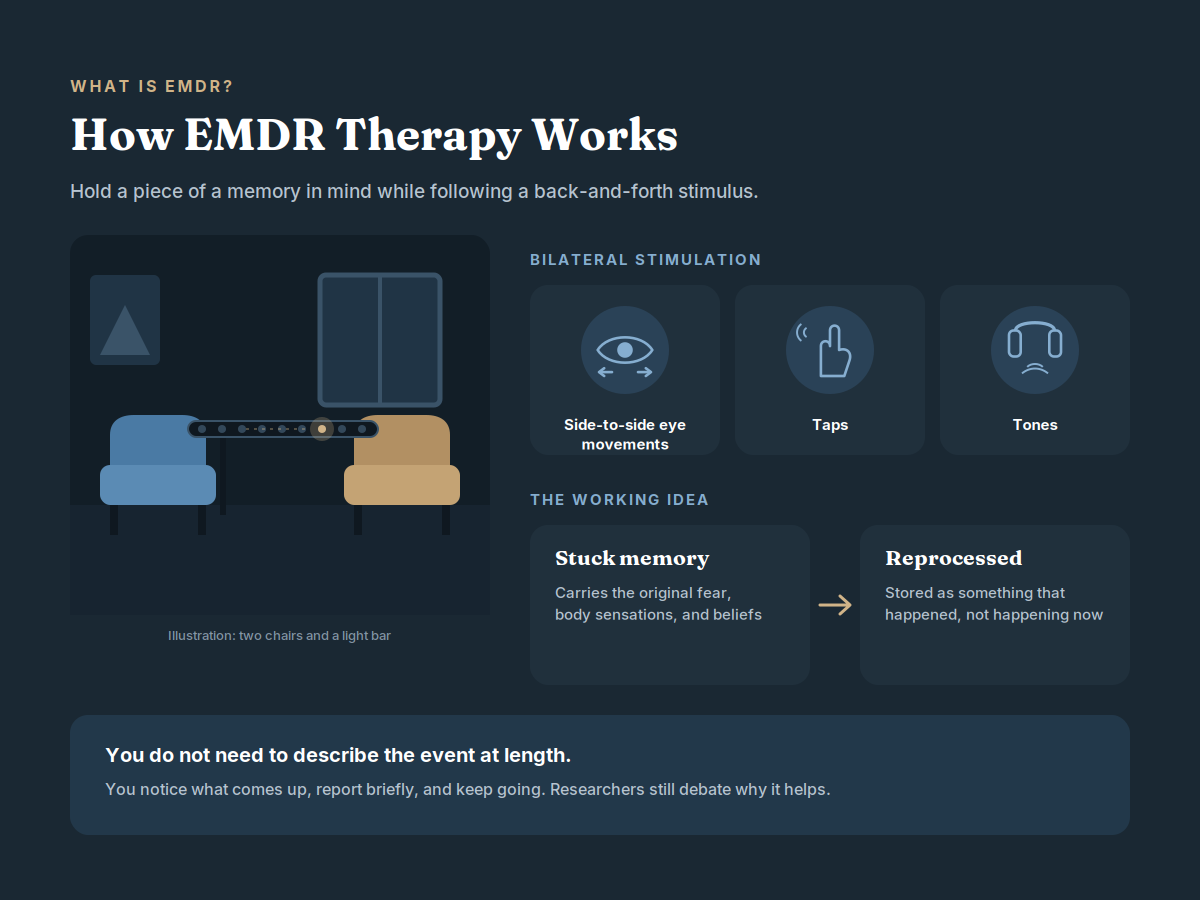
EMDR stands for eye movement desensitization and reprocessing. A trained therapist asks you to hold a piece of a difficult memory in mind for short stretches while following a back-and-forth stimulus, usually side-to-side eye movements, taps, or tones. This is called bilateral stimulation.
The working idea is that traumatic memories can get stuck in raw form, carrying the original fear, body sensations, and beliefs. Reprocessing aims to let the memory be stored as something that happened, not something that is still happening. Researchers still debate why bilateral stimulation helps, and a good therapist will tell you that plainly.
Compared with talk therapy, the main difference is that you do not need to describe the event at length. You notice what comes up, report briefly, and keep going.
Why EMDR matters in addiction and trauma recovery
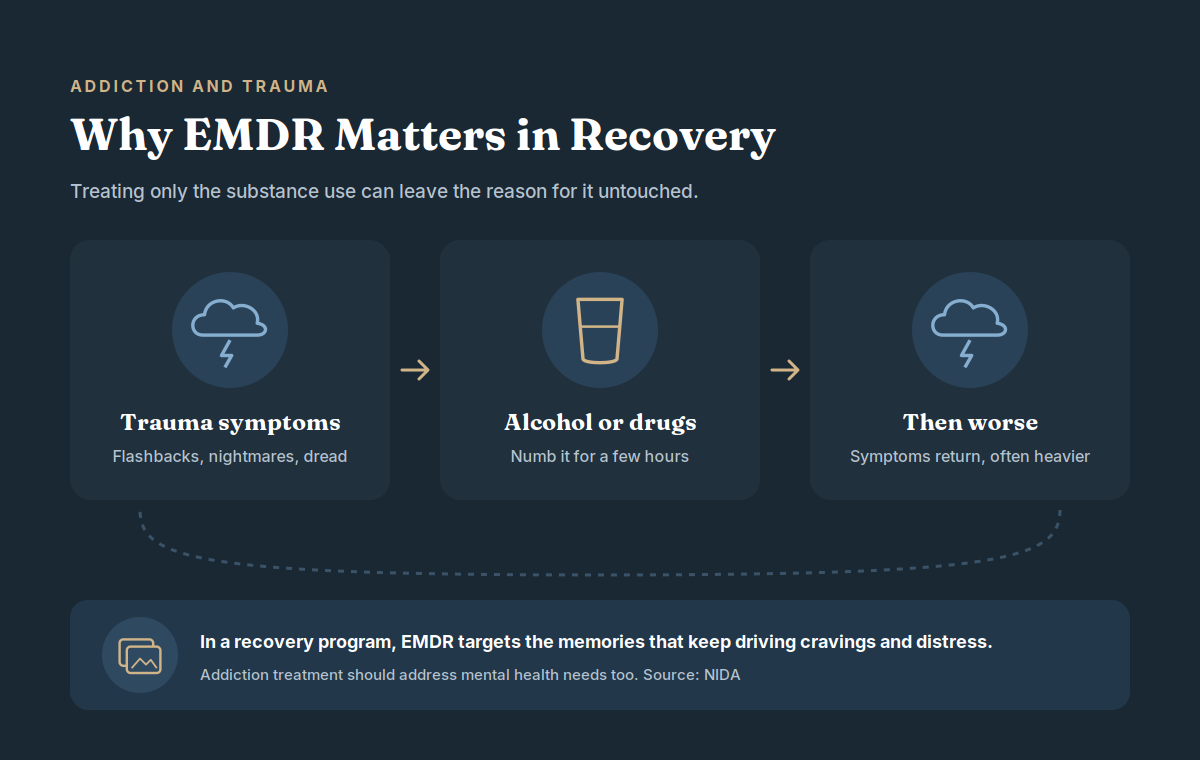
Substance use and trauma often show up together. Alcohol or drugs can numb flashbacks, nightmares, and dread for a few hours, then make everything worse. Treatment that addresses only the substance use can leave the reason for it untouched. The National Institute on Drug Abuse says addiction treatment should address a person's other health needs, including mental health conditions.[1]
The same logic applies to alcohol. The National Institute on Alcohol Abuse and Alcoholism lists treatment resources for alcohol problems, and trauma symptoms are one of many things a person may need help with alongside drinking.[2] In a recovery program, EMDR targets the memories that keep driving cravings and distress.
If you are still sorting out whether anxiety or depression is part of the picture, our posts on anxiety therapy and signs of depression in men cover that ground.
The 8 phases of an EMDR session
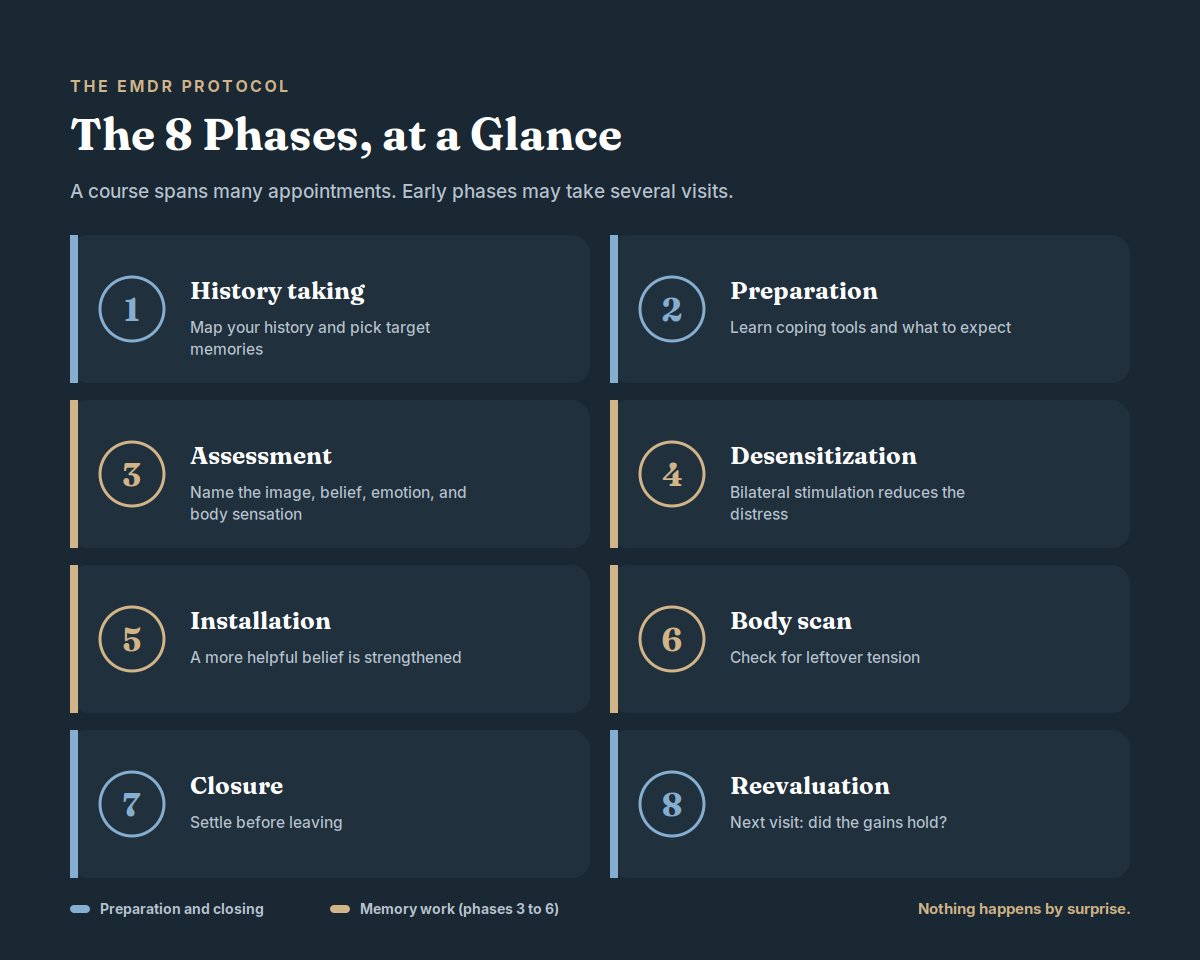
EMDR is not one sitting. It is a protocol with 8 phases, and a course usually spans many appointments. Early phases may take several visits before any memory is touched. This is by design.
Phase | Name | What happens |
|---|---|---|
1 | History taking | You and your therapist map your history and pick target memories. |
2 | Preparation | You learn coping tools and what to expect. |
3 | Assessment | You name the image, belief, emotion, and body sensation tied to one memory. |
4 | Desensitization | Sets of bilateral stimulation reduce the memory's distress. |
5 | Installation | A more helpful belief is strengthened. |
6 | Body scan | You check for leftover tension tied to the memory. |
7 | Closure | You settle before leaving, even if the memory is unfinished. |
8 | Reevaluation | Next visit, you check whether the gains held. |
Step by step
Phases 1 and 2: Mostly conversation. Your therapist asks about your history, including substance use, and teaches calming skills such as slow breathing and picturing a safe place. You practice these before anything harder.
Phase 3: You choose one memory and rate how disturbing it feels, from 0 to 10. You also pick a negative belief, such as "I am not safe," and the belief you would rather hold.
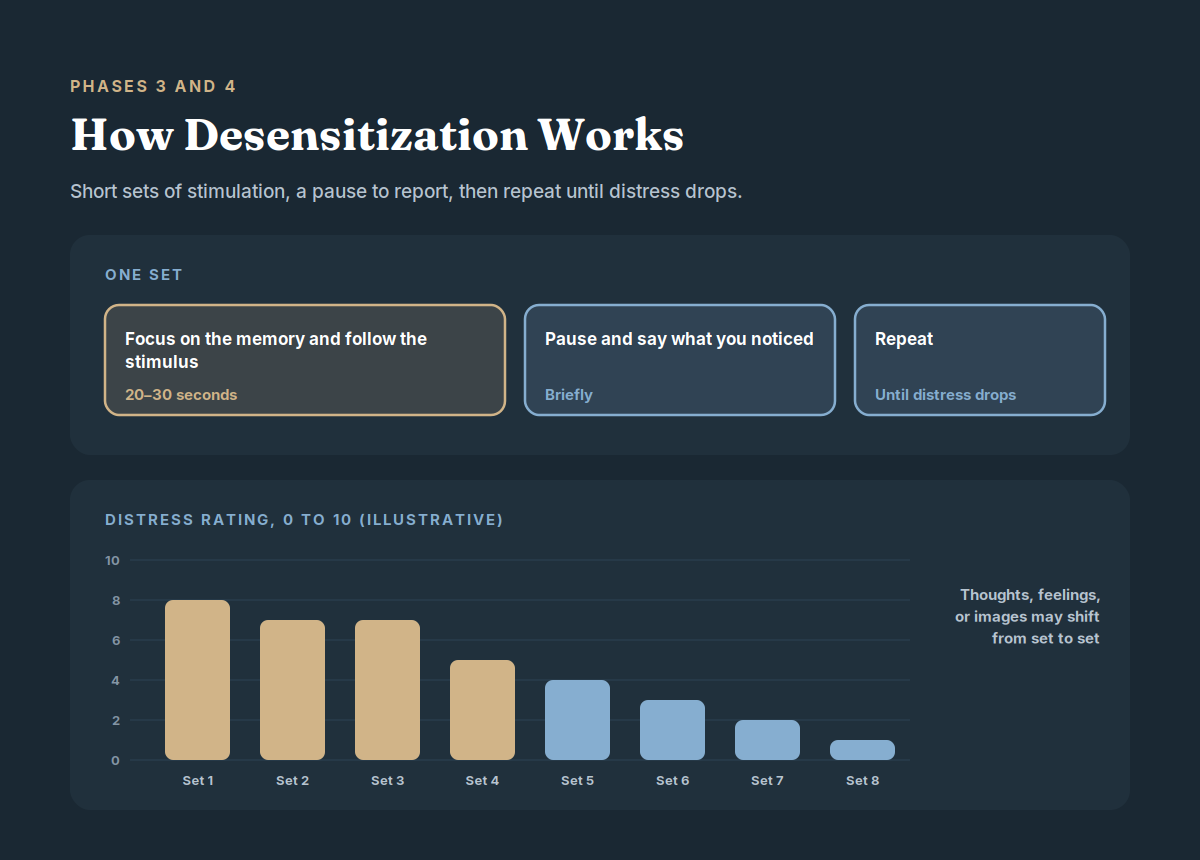
Phase 4: You focus on the memory while following the stimulus for 20 to 30 seconds at a time. Then you pause and say what you noticed. Thoughts, feelings, or images may shift. You repeat this until the distress rating drops.
Phases 5 and 6: You pair the memory with the better belief, then scan your body for any tightness or tension that remains.
Phase 7: Your therapist helps you close the session calmly, whether or not the memory is fully processed.
Phase 8: At the next visit, you both check what changed and decide the next target.
Knowing the phases in this much detail helps many people feel less afraid of EMDR. Nothing happens by surprise.
What to expect during and after an EMDR session
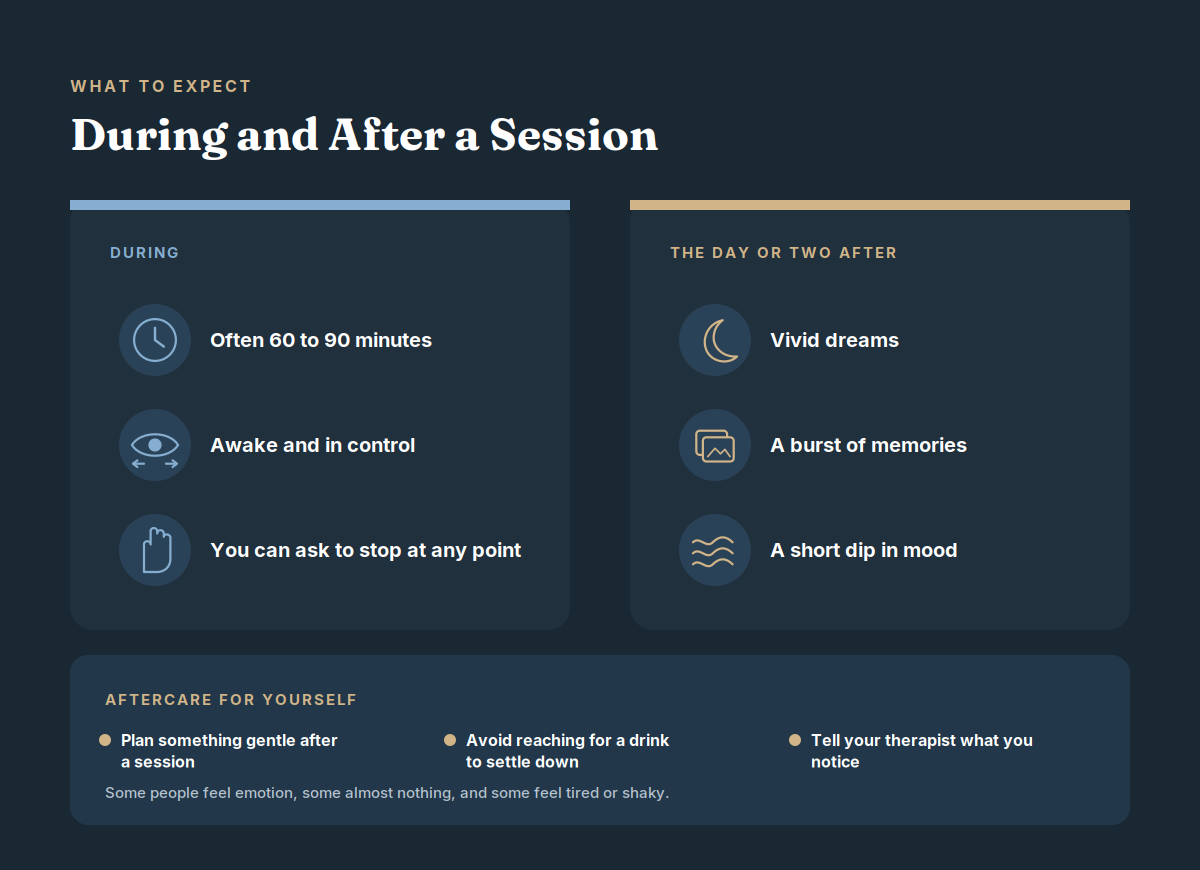
Sessions often run 60 to 90 minutes. During reprocessing you stay awake and in control, and you can ask to stop at any point. Some people feel emotion, some feel almost nothing, and some feel tired or shaky afterward.
In the day or two after, you may notice vivid dreams, a burst of memories, or a short dip in mood. Tell your therapist if this happens. It is part of the work, and it is also information. Plan something gentle after a session if you can, and avoid reaching for a drink to settle down.
Early in recovery, the first month is already demanding. Our guide to the first 30 days of treatment explains why trauma work is often paced carefully.
Who can benefit from EMDR (and who should use caution)
EMDR is most often used for post-traumatic stress disorder (PTSD), which the American Psychiatric Association's diagnostic manual classifies among trauma-related disorders.[3] It may also be used for other distressing memories. People with substance use and trauma histories are common candidates.
Caution makes sense in some situations:
You are in active withdrawal or heavily intoxicated. Medical stabilization comes first, which is what medical detox is for.
You are in immediate danger or having thoughts of suicide. Safety planning comes first. In the U.S., you can call or text 988, the Suicide & Crisis Lifeline.[4]
You frequently dissociate (lose track of the present). You may need more preparation time before reprocessing.
You do not yet have steady coping skills. Phase 2 can be extended.
A clinician should make this call with you, not a checklist found online.
How EMDR fits into a comprehensive treatment plan at Fort Worth Wellness
At Fort Worth Wellness, trauma therapy is one part of care, not a standalone fix. The American Society of Addiction Medicine's criteria call for person-centered treatment plans for addiction and co-occurring conditions.[5] That is how we think about EMDR too.
For many people the path looks like this: stabilize through detox if needed, build skills, then begin trauma work alongside relapse prevention. Our dual diagnosis program treats substance use and mental health conditions together, and our mental health residential care offers a structured setting when daily life is too unsteady for outpatient work. After you leave, aftercare and alumni support helps you keep the gains.
If you are weighing who should guide you, see how to choose the right mental health professional.
Taking the next step: getting started with EMDR
Start with an assessment. A clinician will ask about your substance use, your trauma history, your current safety, and what you hope will change. From there, you can decide together whether EMDR is the right tool and when to begin.
Bring questions. Ask how many preparation visits to expect, how the therapist handles a hard session, and how EMDR will be coordinated with your other care. If you are not sure where to look, SAMHSA's treatment locator and helpline can point you toward options, and NIDA lists the same number, 1-800-662-HELP (4357).[1]
Frequently Asked Questions
Q: What is EMDR therapy, and what does EMDR stand for?
A: EMDR stands for eye movement desensitization and reprocessing. It is a structured therapy in which you briefly focus on a distressing memory while following side-to-side eye movements, taps, or tones, so the memory becomes less painful over time.
Q: How many sessions of EMDR does it usually take to see results?
A: It varies. A single, recent event may need fewer sessions than long-standing or repeated trauma. Early visits are preparation, so expect several appointments before reprocessing begins. Your therapist can give an estimate after the history phase.
Q: Does EMDR therapy hurt, or will I have to relive my trauma in detail?
A: It does not cause physical pain. Emotions can come up, and some sessions are tiring. You do not have to describe the event in detail, and you can pause or stop at any time.
Q: Can EMDR help with substance use disorder and co-occurring PTSD?
A: It can be part of treatment for people who have both. EMDR targets trauma memories, not the addiction itself, so it works best alongside relapse prevention, medical care when needed, and ongoing support.
Q: Is EMDR therapy safe, and who is not a good candidate for it?
A: It is generally considered safe when delivered by a trained clinician. It is usually delayed for people in withdrawal, in immediate crisis, or without basic coping skills. A clinician should assess you first.
Conclusion
EMDR is a paced, 8-phase method for helping the brain process memories that still feel current. You prepare first, work on one memory at a time, and close each session safely. For people living with both addiction and trauma, it can be a meaningful piece of recovery.
If you or someone you love is ready to ask about it, contact Fort Worth Wellness. We will talk through your history, answer your questions, and help you decide where to begin.
References
National Institute on Drug Abuse. NIDA home: treatment information and the SAMHSA Treatment Locator. - https://nida.nih.gov
National Institute on Alcohol Abuse and Alcoholism. Treatment for alcohol problems and Alcohol Treatment Navigator. - https://www.niaaa.nih.gov
American Psychiatric Association. Diagnostic and Statistical Manual of Mental Disorders (DSM-5-TR). - https://www.psychiatry.org/psychiatrists/practice/dsm
Substance Abuse and Mental Health Services Administration. SAMHSA Home: helplines, 988 Suicide & Crisis Lifeline, and treatment locators. - https://www.samhsa.gov
American Society of Addiction Medicine. The ASAM Criteria, 4th Edition. - https://www.asam.org