TL;DR
Both formats can work. The better question is which one you will actually attend, week after week, while you are recovering.
Telehealth saves travel time and is easier to fit around work and childcare. It depends on a private space and a steady connection.
In-person care is usually the better choice when cravings are strong, home is unstable, or you may need medical oversight.
A hybrid plan lets you start in person and shift to video, or the reverse, as your needs change.
Whichever format you pick, look for an anxiety therapist who also understands substance use.
Table of Contents
Comparing formats: schedule, privacy, support, and effectiveness
How to choose the right anxiety therapist at Fort Worth Wellness
Introduction
You have decided to get help for anxiety, and now there is another decision: a screen or a couch? If you are in recovery from alcohol or drugs, or thinking about it, this choice carries more weight than it does for most people. An anxiety therapist can only help if you can keep showing up.
This guide is about format, not method. We cover how each option works, where each one falls short, and how to choose. If you want to understand the techniques themselves, our post on anxiety therapy: what works and how to start covers them. Here, we focus on logistics, privacy, and safety in the Fort Worth area.
How anxiety and addiction recovery are connected
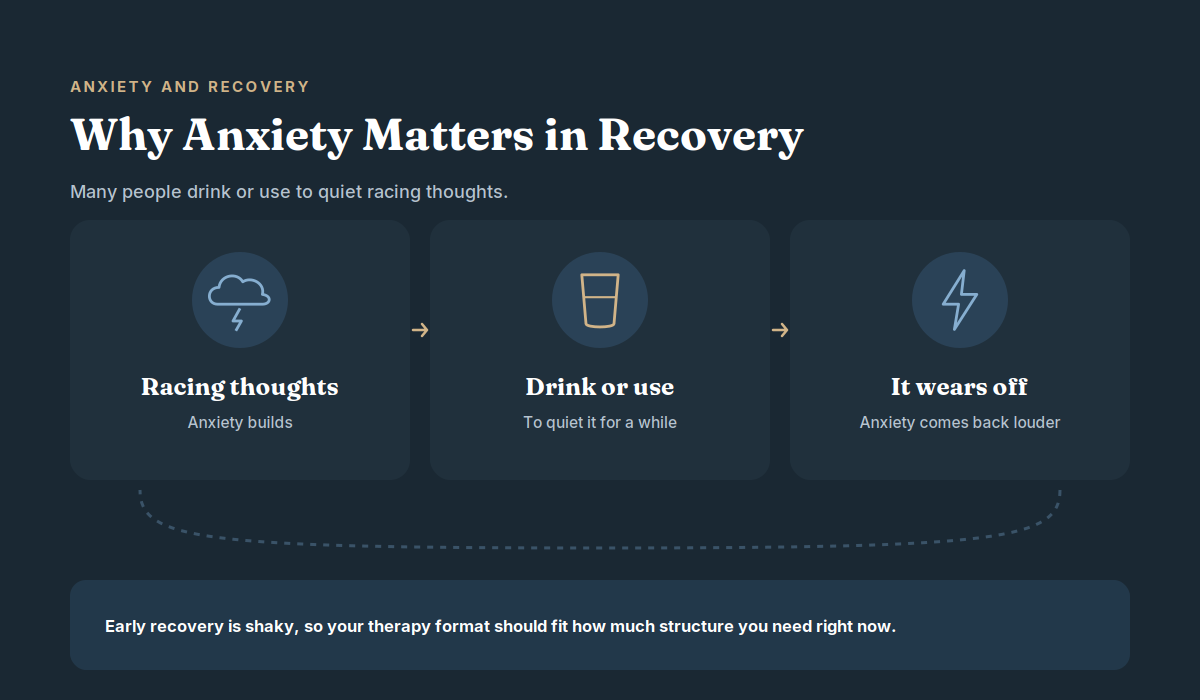
Anxiety and substance use often travel together. Many people drink or use to quiet racing thoughts, then find the anxiety comes back louder when the substance wears off. SAMHSA, the federal agency that leads behavioral health efforts in the United States, runs a national helpline and a treatment locator for people dealing with mental health and substance use together.[1]
This matters for format because early recovery is a shaky time. Sleep is poor, nerves are raw, and old coping habits are close by. The ASAM Criteria, the guidelines from the American Society of Addiction Medicine, use a person-centered approach to build treatment plans for addiction and co-occurring conditions.[2] In plain terms, your plan should fit your situation, including how much structure you need right now.
What to expect from an in-person anxiety therapist
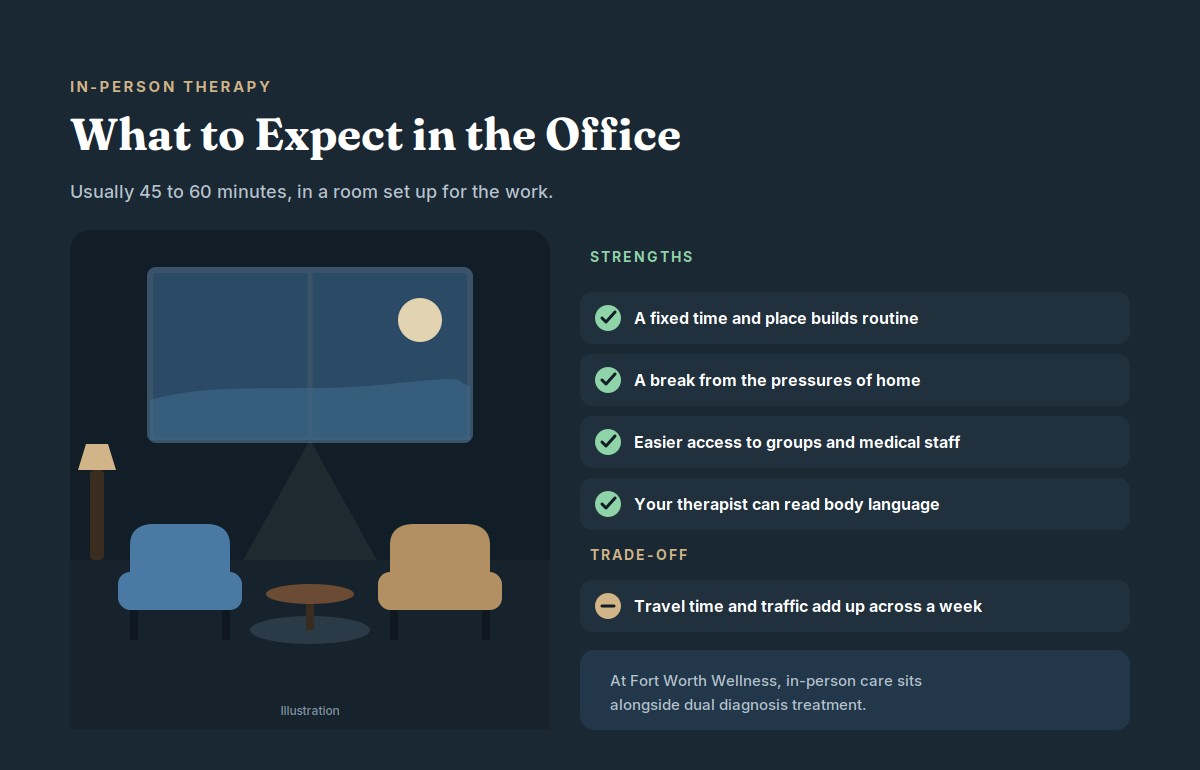
You go to an office, usually for 45 to 60 minutes. You leave home, which for some people is itself a relief. The room is set up for the work, and the therapist can read your body language, including the things you do not say out loud.
In-person care also makes it easier to add other services under one roof. Some people need a psychiatric evaluation, a group session, or a check-in with a case manager on the same day. At Fort Worth Wellness, in-person care sits alongside dual diagnosis treatment, which addresses anxiety and substance use together.
Fixed time and place, which builds routine
A break from the pressures of home
Easier access to groups and medical staff
Travel time and traffic, which add up across a week
What to expect from a telehealth anxiety therapist
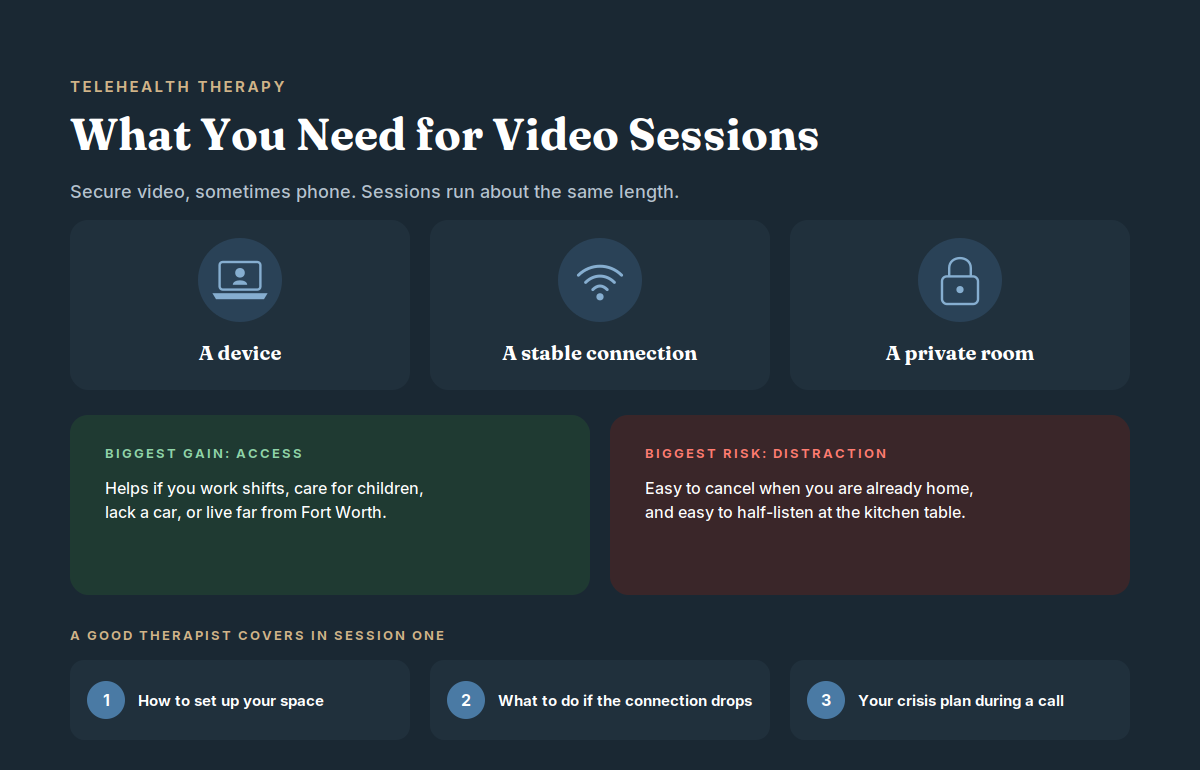
Telehealth means you meet your therapist by secure video, and sometimes by phone. You need a device, a stable internet connection, and a room where you can talk without being overheard. Sessions run about the same length as office visits.
The biggest gain is access. If you work shifts, care for children, lack a car, or live far from Fort Worth, video removes the obstacle that keeps many people from starting. The biggest risk is distraction. It is easy to cancel a session when you are already home, and easy to half-listen with a laptop on the kitchen table.
A good anxiety therapist will talk with you in the first session about how to set up your space, what to do if the connection drops, and what the plan is if you hit a crisis during a call.
Comparing formats: schedule, privacy, support, and effectiveness
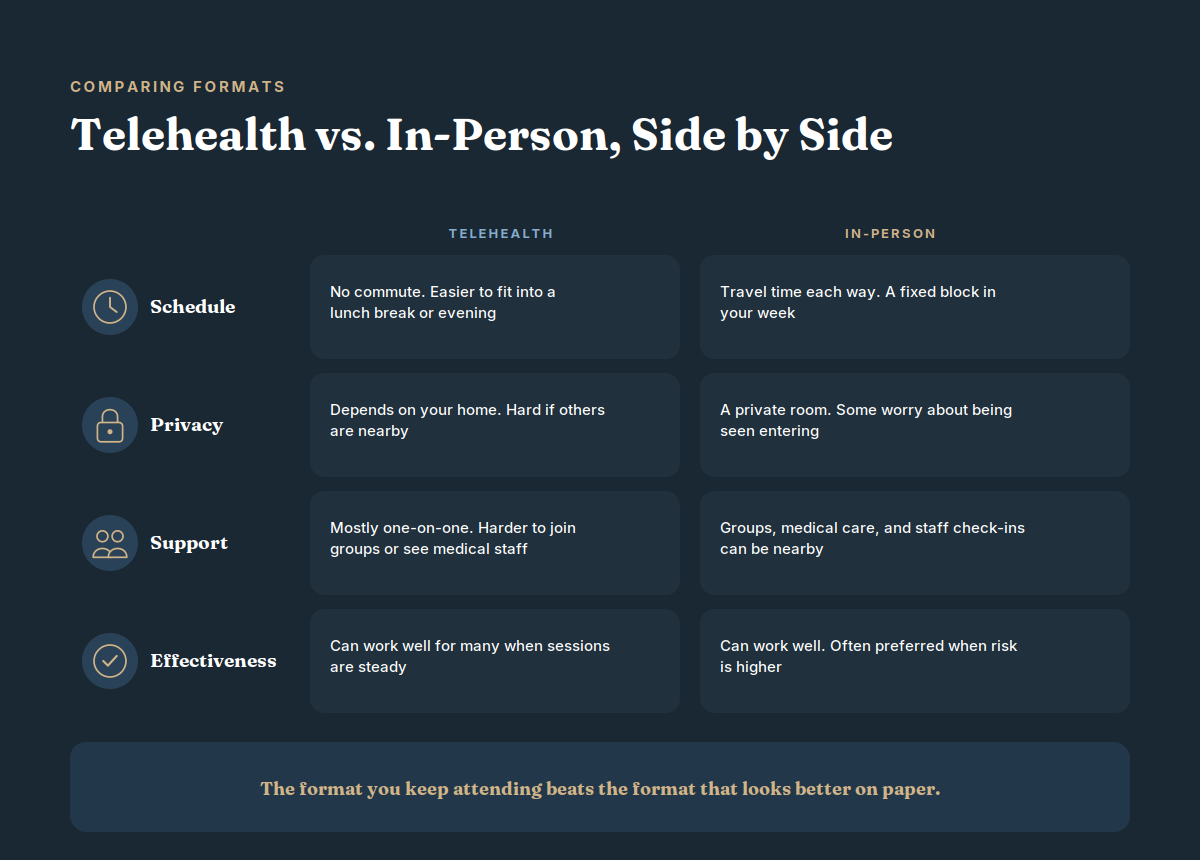
The table below puts the two formats side by side on the four things people ask about most.
Factor | Telehealth | In-person |
|---|---|---|
Schedule | No commute. Easier to fit into a lunch break or an evening. | Travel time each way. Fixed block in your week. |
Privacy | Depends on your home. Hard if others are nearby. | Private room. Some people worry about being seen entering. |
Support | Mostly one-on-one. Harder to join groups or see medical staff. | Groups, medical care, and staff check-ins can be nearby. |
Effectiveness | Can work well for many people when sessions are steady. | Can work well. Often preferred when risk is higher. |
On effectiveness, we will be careful. The sources we reviewed do not give a head-to-head result for anxiety treatment by format, so we will not invent one. What we see in practice is that the format you keep attending beats the format that looks better on paper.
Privacy deserves a second look. If you share a small apartment or a roommate knows nothing about your recovery, video may not feel safe enough to be honest. Therapy only works if you can be honest.
When in-person care may be the better choice for recovery
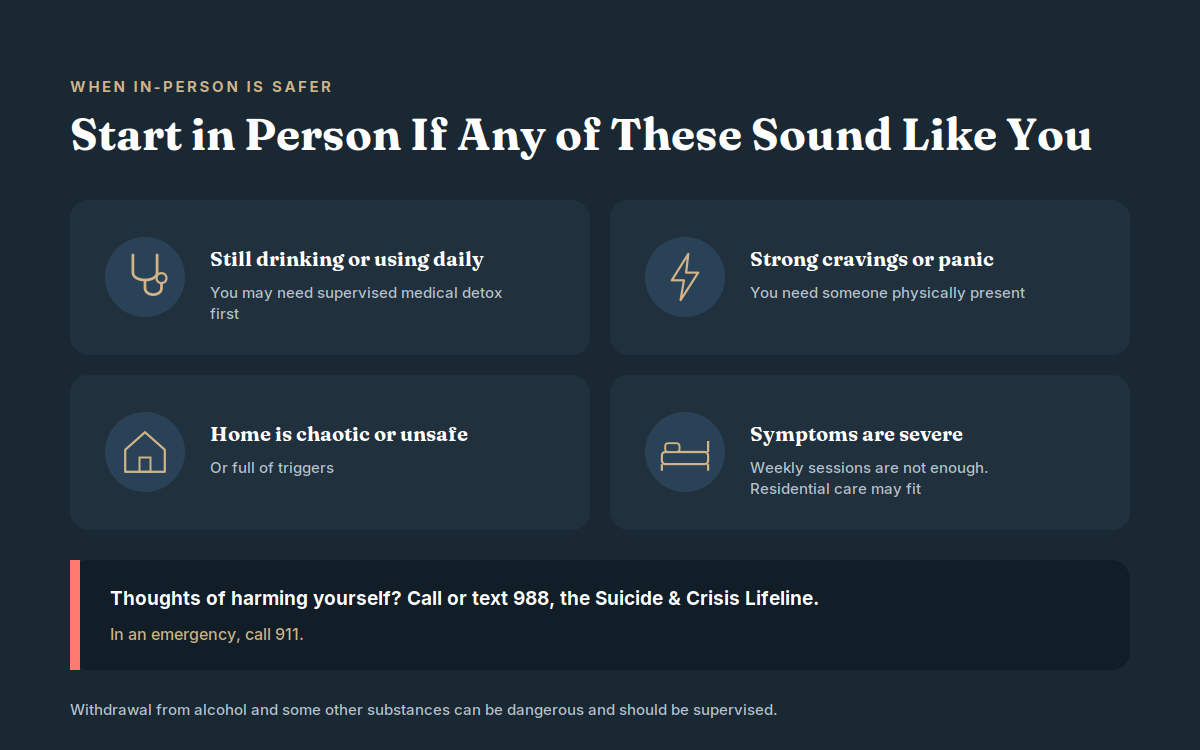
Some situations call for more structure than video can give. If any of these sound like you, an in-person anxiety therapist is usually the safer starting point.
You are still drinking or using daily and may need medical detox first. Withdrawal from alcohol and some other substances can be dangerous and should be supervised.
Cravings or panic are hitting hard enough that you need someone physically present.
Home is chaotic, unsafe, or full of triggers.
You have had thoughts of harming yourself. Call or text 988, the Suicide & Crisis Lifeline, which SAMHSA lists among its helplines.[1]
Your symptoms are severe enough that weekly sessions are not enough. Mental health residential care may be a better fit.
If you are unsure whether your anxiety has reached that point, our post on eight warning signs may help you sort it out.
Hybrid options: combining telehealth and in-person sessions
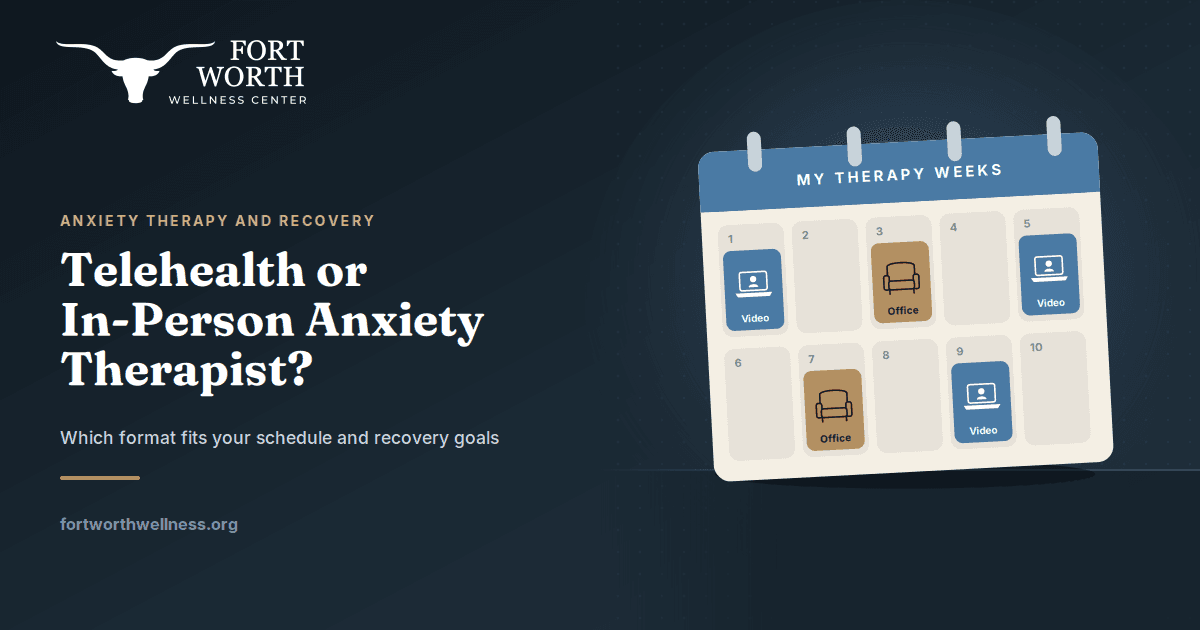
You do not have to choose once and stay there. Many people start in person to build trust and a baseline, then move to video when work gets busy or when they are stable. Others do the reverse: begin on video to get started quickly, then come in when they need more.
A hybrid plan can look like this:
In-person session every other week, video check-in in between
Video therapy during the week, with an in-person group on weekends
Video after a residential stay, supported by aftercare and alumni services
The risk with any arrangement that mixes formats is losing continuity. Ask to keep the same therapist across both so you are not retelling your story.
[Insert image of a calendar showing alternating video and office sessions here]
How to choose the right anxiety therapist at Fort Worth Wellness
Start with three questions. Where can you talk freely? How many hours a week can you really protect? And how steady are you right now, on a scale from "mostly fine" to "barely holding on"? Your answers point toward a format.
Then look at the person, not just the format. A licensed anxiety therapist who understands addiction will plan around cravings, triggers, and medication, rather than treating anxiety as a separate problem. Clinicians use the DSM-5-TR to define and classify mental disorders, which helps them reach a clearer diagnosis and plan.[3] If you also want to talk through medication, read how to talk to your doctor about medicine for anxiety. For credentials and cost, see how to choose the right mental health professional.
If you want to start by understanding your options, use the SAMHSA Treatment Locator or call 1-800-662-HELP (4357).[4] For alcohol in particular, NIAAA offers an Alcohol Treatment Navigator.[5] At Fort Worth Wellness, our team can help you match format to need in a first conversation.
Frequently Asked Questions
Q: Is telehealth as effective as in-person sessions with an anxiety therapist?
A: For many people it can be, especially when sessions are regular and the space is private. The sources we reviewed do not give a direct comparison, so we cannot quote a number. Choose the format you will keep attending, and switch if it stops working.
Q: Can an anxiety therapist treat anxiety and substance use disorders at the same time?
A: Yes, when the therapist is trained in both. This is called dual diagnosis care. Treating only one tends to leave the other free to pull you back, so the plan should address both together.[2]
Q: Is telehealth a good option in early recovery, or do I need in-person support first?
A: It depends on how stable you are. If you are in active withdrawal, facing strong cravings, or living somewhere unsafe, start in person. If you are stable and have a private space, video can be a reasonable start.
Q: Can I switch between telehealth and in-person therapy if my needs change?
A: Usually yes. Tell your anxiety therapist early if video is not working or if you feel worse. Ask to keep the same therapist so your progress carries over.
Q: What should I look for when choosing an anxiety therapist for recovery support?
A: Look for a license, experience with substance use, a clear plan for crises, and a willingness to coordinate with your doctor. You should feel able to be honest with them. If not, it is fine to try someone else.
Conclusion
The right anxiety therapist format is the one that fits your week, protects your privacy, and gives you enough support for where you are in recovery. Video is easier to start. In-person is stronger when risk is higher. Hybrid lets you adjust. If you are not sure which fits, call Fort Worth Wellness and talk it through with our team. You do not have to decide alone, and you can change your mind later.
References
SAMHSA. Home | SAMHSA - Substance Abuse and Mental Health Services Administration. - https://www.samhsa.gov
American Society of Addiction Medicine. ASAM - American Society of Addiction Medicine. - https://www.asam.org
American Psychiatric Association. Psychiatry.org - DSM. - https://www.psychiatry.org/psychiatrists/practice/dsm
National Institute on Drug Abuse. NIDA.NIH.GOV | National Institute on Drug Abuse (NIDA). - https://nida.nih.gov
National Institute on Alcohol Abuse and Alcoholism. National Institute on Alcohol Abuse and Alcoholism (NIAAA). - https://www.niaaa.nih.gov